
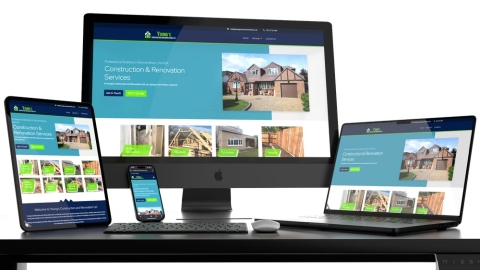
Websites for Norfolk Trades
1. Introduction: Why Norfolk Trades Need a Professional Website
A van full of tools and a reputation built on referrals used to be enough. That era has quietly ended. Homeowners across Norfolk now reach for a phone before they reach for a phone book, and the businesses that show up first in that search are the ones that win the job. A tradesperson without a website isn't invisible exactly, but they are relegated to a shrinking pool of leads that arrive purely through word of mouth. For builders, electricians, plumbers, and every other trade operating between Norwich and the coast, a professional website has become less of a luxury and more of a foundational business asset, as essential as a van, a toolkit, or public liability insurance.
This shift hasn't happened overnight, but it has accelerated. Trade businesses that once relied entirely on local reputation now compete in a digital marketplace where visibility, credibility, and speed of response determine who gets the enquiry. The following exploration unpacks what a genuinely effective website looks like for a Norfolk trade business, why local targeting matters so much, and how to avoid the pitfalls that leave otherwise excellent tradespeople languishing on page two of the search results.
2. The Changing Face of Trade Marketing in Norfolk
2.1 From Word of Mouth to Online Search
Recommendation has always mattered in the trades. A neighbour's endorsement or a satisfied customer's referral once formed the backbone of a builder's or plumber's client list. That dynamic hasn't vanished, but it has been supplemented, and in many cases superseded, by digital discovery. Someone who hears a name mentioned in passing will still, more often than not, verify that recommendation with a quick search before picking up the phone. If nothing credible appears, scepticism creeps in, however glowing the original tip-off was.
2.2 The Rise of "Near Me" Searches
Search behaviour has grown noticeably more localised. Phrases such as "web designer near me" or "electrician near me" reflect a broader pattern: people want proximity, not just competence. This applies just as forcefully to trades. A homeowner in Wymondham searching for a roofer isn't interested in a national franchise with a call centre in another county; they want someone who understands local building styles, weather patterns, and travel times. Trade businesses that fail to signal this local relevance through their website content risk being filtered out before a phone call ever happens.
3. What Makes a Website Effective for Tradespeople
3.1 Mobile Responsiveness
The overwhelming majority of trade enquiries begin on a smartphone, frequently while someone is standing in a leaking kitchen or staring up at a damaged roof tile. A website that renders awkwardly on a small screen, with text too tiny to read and buttons too fiddly to tap, will lose that visitor within seconds. Responsive design isn't a cosmetic nicety; it's the difference between capturing an urgent enquiry and losing it to a competitor whose site simply behaves better on mobile.
3.2 Fast Load Times
Patience online is famously thin. A page that takes more than a couple of seconds to load will haemorrhage visitors, particularly on mobile data connections in rural parts of Norfolk where signal strength can be patchy. Heavy, unoptimised images and bloated code are the usual culprits. A lean, quick-loading site isn't just pleasant to use; it's rewarded by search engines, which factor speed into ranking decisions.
3.3 Clear Calls to Action
Every page should nudge the visitor towards a specific next step: call now, request a quote, or send a message. Ambiguity is the enemy of conversion. A site stuffed with information but lacking an obvious "what do I do next" prompt leaves potential customers to work it out for themselves, and many simply won't bother. Prominent phone numbers, quote request buttons, and simple contact forms should punctuate the browsing experience without becoming intrusive.
4. Core Website Features Every Norfolk Trade Business Needs
4.1 Service Pages
A generic "services" list buried on the homepage undersells what a business actually does. Dedicated pages for each core service, such as kitchen fitting, rewiring, roof repairs, and garden landscaping, allow far more detailed, keyword-relevant content to be built out. This granularity helps both the visitor, who finds precisely the information they need, and the search engine, which can match specific queries to specific pages rather than a single catch-all.
4.2 Portfolio and Project Galleries
Trades are inherently visual. A gallery of completed extensions, rewired consumer units, or newly landscaped gardens does more to build confidence than paragraphs of self-description ever could. Photographic evidence of craftsmanship, ideally accompanied by short contextual notes on the scope and location of each job, transforms abstract claims of quality into something tangible and verifiable.
4.3 Customer Reviews and Testimonials
Third-party validation carries disproportionate weight in trade selection, given the risk involved in letting a stranger work on one's home. Genuine testimonials, ideally sourced from platforms like Google or Checkatrade and embedded directly on the site, reduce the perceived risk of engaging a new supplier. Specificity matters here: a review naming the exact job and outcome will always outperform a vague, generic compliment.
4.4 Contact Forms and Click-to-Call
Not every visitor wants to speak on the phone straight away, and not every enquiry happens during business hours. A well-placed contact form catches those who prefer to type out their requirements, while click-to-call functionality removes friction for mobile users who simply want to dial immediately. Offering both channels widens the net rather than forcing a single preference on every visitor.
5. Local SEO for Norfolk Tradespeople
5.1 Targeting Norwich and the Surrounding Area
Norwich, as the county's largest population centre, represents the single richest source of trade enquiries in Norfolk. Content that explicitly references Norwich, through service pages, location-specific landing pages, and locally flavoured blog posts, helps establish topical relevance in the eyes of search engines. Nearby satellite towns such as Wymondham, Attleborough, and Dereham offer secondary opportunities, particularly for trades willing to travel a modest radius from the city. Norfolk trade businesses looking to strengthen their own presence often turn to specialist website designers Norfolk businesses trust to handle this kind of local targeting properly.
5.2 Location Pages for Great Yarmouth, King's Lynn, and Beyond
Norfolk is a sprawling county, and a single "areas covered" page rarely does justice to the geographic nuance of trade demand. Dedicated pages for Great Yarmouth, King's Lynn, Cromer, and Diss allow a business to speak directly to residents of each area, referencing local landmarks or known housing stock where relevant. This kind of granular targeting signals genuine familiarity rather than a bolt-on, one-size-fits-all approach to service coverage.
5.3 Google Business Profile Optimisation
A website rarely operates in isolation from a well-maintained Google Business Profile. Accurate opening hours, up-to-date photographs, a correctly categorised trade listing, and a steady trickle of fresh reviews all feed into local map pack visibility, often the very first thing a searcher sees before they ever click through to a website. Neglecting this profile undermines even the best-built site.
6. Website Needs by Trade
6.1 Builders and Building Contractors
Builders benefit enormously from visual storytelling: before-and-after extension photography, timelapse-style project galleries, and clearly explained process pages that demystify what a build actually involves. Given the scale of investment typically at stake, prospective clients want reassurance around insurance, accreditation, and past project scale before they'll pick up the phone.
6.2 Electricians
Trust and safety credentials dominate decision-making for electrical work. NICEIC or NAPIT registration, clear explanations of certification for rewiring or consumer unit upgrades, and prominent emergency contact options all reduce hesitation. Electricians who explain technical work in plain, jargon-light language tend to convert better than those who assume prior knowledge.
6.3 Plumbers
Urgency defines much plumbing demand: burst pipes and failed boilers rarely wait for convenient timing. A plumber's website should foreground emergency response availability, ideally with a highly visible phone number and an indication of typical response times. Seasonal content around boiler servicing or frozen pipe prevention also captures searches tied to Norfolk's colder months.
6.4 Roofers
Roofing work is almost always sold on trust, given how difficult it is for a homeowner to inspect the quality of work themselves. Detailed photographic evidence, guarantees on workmanship, and clear explanations of materials used all help bridge that information gap. Storm-damage or emergency repair pages can also capture time-sensitive search demand following bad weather.
6.5 Landscapers and Garden Designers
This trade leans heavily on aspiration and visual inspiration. Rich galleries showing design transformations, alongside content addressing Norfolk's particular soil types and coastal exposure in areas like Cromer or Great Yarmouth, help position a landscaper as genuinely knowledgeable about local growing conditions rather than generically capable.
6.6 Tree Surgeons
Tree surgery websites should clearly address safety certification, insurance, and any relevant council permissions around protected trees, a subject many homeowners are unaware of until it becomes relevant. Emergency storm-damage response, much like roofing, represents a valuable seasonal content opportunity.
7. Building Trust Online
7.1 Certifications and Accreditations
Trade-specific accreditation logos, such as Gas Safe, NICEIC, and FMB membership, function as instant trust shorthand. Displaying these prominently, rather than burying them in a footer, reassures visitors that a business meets recognised industry standards.
7.2 Case Studies and Before/After Galleries
A short written case study, paired with photographic evidence, does more persuasive work than a paragraph of marketing copy. Describing the brief, the challenge, and the resolution turns a completed job into a narrative that prospective clients can imagine themselves within.
7.3 Transparent Pricing Guidance
Full itemised pricing rarely makes sense for bespoke trade work, but indicative price ranges or a clear explanation of how quotes are calculated reduce the anxiety many customers feel before making contact. Ambiguity around cost is one of the most common reasons enquiries stall before they even begin.
8. Content That Converts
8.1 Blog Posts and Seasonal Advice
Regularly published content, such as advice on preparing gutters for autumn storms or when to schedule a boiler service ahead of winter, keeps a site fresh in the eyes of search engines while demonstrating genuine expertise. Seasonal relevance also aligns naturally with the rhythms of Norfolk's weather and housing stock.
8.2 FAQs Addressing Common Concerns
Frequently asked questions pages tackle hesitation head-on: how long will the job take, do you offer guarantees, what happens if something goes wrong. Addressing these proactively removes friction that might otherwise prevent an enquiry from ever being submitted.
9. The Role of Branding in Trade Websites
9.1 Consistent Colours and Logo Use
A coherent visual identity, with consistent colours, typography, and logo placement, signals professionalism and permanence. Trade businesses that appear visually consistent across their website, van signage, and business cards come across as considerably more established than those with a mismatched, ad hoc appearance.
9.2 Professional Photography
Genuine, well-lit photography of real jobs and real team members outperforms generic stock imagery every time. Stock photos, however polished, tend to feel impersonal and can even undermine trust if a visitor senses the imagery doesn't reflect the actual business behind it.
10. Common Mistakes Norfolk Trade Websites Make
10.1 Outdated Templates
A site that looks visibly dated, with clunky layouts, tiny unreadable text, and Flash-era design conventions, quietly erodes credibility before a single word is read. Visitors make snap judgements about competence based on visual polish alone, however unfair that inference might be.
10.2 Missing or Buried Contact Information
It sounds elementary, yet countless trade websites still hide their phone number several clicks deep, or omit it from mobile menus entirely. Every page should make contact effortless, not a scavenger hunt.
10.3 Ignoring Mobile Users
Beyond simple responsiveness, some trade sites fail mobile users in subtler ways: forms that are fiddly to complete on a touchscreen, or navigation menus that obscure content behind clumsy taps. Genuine mobile-first thinking goes beyond merely "not breaking" on a smaller screen.
11. Choosing a Web Design Partner in Norfolk
11.1 Local Knowledge Matters
A web designer familiar with Norfolk's towns, trade landscape, and search behaviour brings something a generic national agency cannot easily replicate: contextual insight. Understanding which towns cluster together geographically, or how coastal versus inland demand differs, shapes far more effective content strategy.
11.2 In-House Versus Outsourced Development
Agencies that build everything in-house typically offer greater consistency and control over the finished product, since no element of the build is handed off to disconnected third parties. This tends to translate into a smoother client experience, with a single point of contact who understands the project from initial consultation through to launch, rather than a fragmented handoff between multiple specialists.
12. Conclusion: Investing in a Website That Works as Hard as You Do
A website for a Norfolk trade business isn't a static brochure to be built once and forgotten. It's an active sales tool, one that should work through the night, answer the questions a phone call can't always address immediately, and quietly build the kind of trust that turns a browsing visitor into a booked job. Builders, electricians, plumbers, roofers, landscapers, and tree surgeons operating across Norwich, Great Yarmouth, King's Lynn, and the county's smaller towns all compete in the same crowded digital space. The businesses that invest properly in mobile-friendly design, genuine local targeting, and content that speaks directly to Norfolk homeowners will consistently outperform those still relying on reputation alone.
This is precisely the kind of transformation Designtec, one of the leading website designers Norfolk has to offer, has delivered for hundreds of trade businesses across Norfolk and Suffolk. Working from our Norwich offices, our in-house team has spent over twenty-four years building websites for builders, electricians, plumbers, roofers, landscapers, and countless other tradespeople, taking each client from an initial conversation through to a finished site that generates genuine enquiries. Because everything is handled in-house, from design to development to ongoing SEO support, clients benefit from a single point of contact who understands their business throughout the whole process, rather than being passed between departments. In a marketplace this competitive, a website isn't just where a trade business is found; it's often the very reason it gets chosen at all, and it's why so many Norfolk trades have trusted Designtec to build theirs.